
6 Reasons Why the Octopus Is the Mascot of Steampunk
Abyssal monster, industrial symbol, muse of Victorian literature and pop icon ahead of its time: the octopus reigns supreme in the steampunk imagination. From Jules Verne to Cthulhu, from tentacular rail networks to the cutest steam-powered mascots, this cephalopod has more than earned its status. An exploration of an eight-armed obsession.
Long hidden in the depths of the oceans, the octopus resurfaced in the Western collective imagination in the 19th century—at the exact moment industrial modernity was gaining momentum. Biological coincidence or cultural synchronicity? In the Victorian era, the world accelerates: machines transform landscapes, and networks—railway, commercial, imperial—spread their tentacles across the globe. The octopus becomes a powerful metaphor: unsettling, captivating, and unmistakably modern. But when—and through what twists and turns—did the octopus become the unofficial mascot of steampunk?
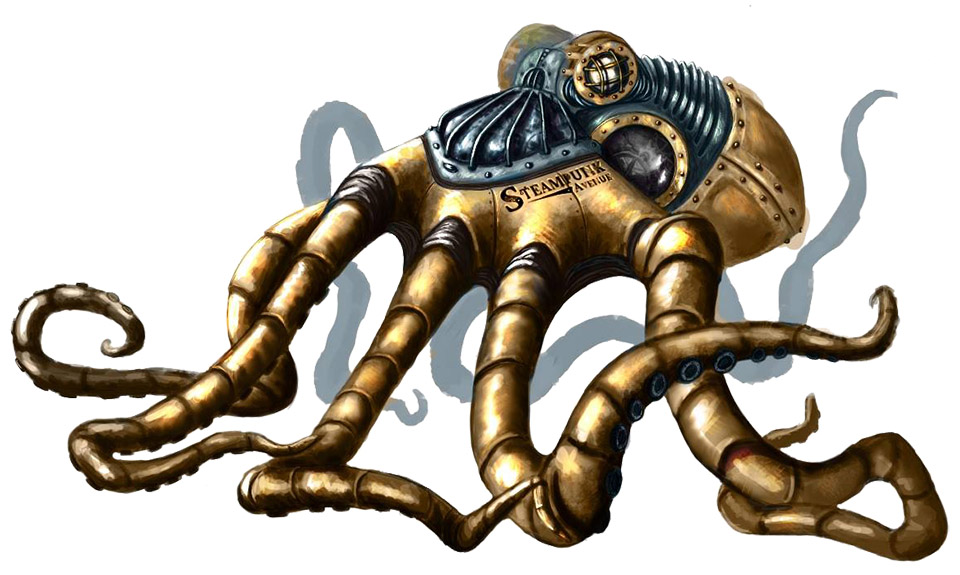
Image credit: Steampunk Avenue


Before steampunk: the octopus in the Victorian imagination
Long before it became a retrofuturistic icon, the octopus already haunted 19th-century minds. At a time when the deep sea remained largely unexplored, it embodied every fear associated with the unknown: a boneless, tentacled body slipping out of the abyss like a living nightmare. Scientific accounts—often imprecise—blended with popular fantasies, and illustrators readily depicted it as a gigantic, almost mythological creature.
In newspapers, engravings and adventure novels, the octopus became the monstrous face of a world humanity was beginning to explore… without truly understanding it. It symbolised a nature still resistant to science and machinery—a reminder that progress had limits. A perfect figure for an era fascinated by progress yet haunted by its own limits. All steampunk had to do was haul the octopus out of the deep and bolt it onto a framework of brass, steam and imagination.
How the octopus became steampunk’s mascot
From adventure literature to Lovecraftian myth, from the Industrial Revolution to the most iconic mascots of the steampunk scene, the octopus gradually established itself within the steampunk imagination. Each tentacle tells a different story—literary influence, industrial anxiety, scientific fascination and sheer aesthetic pleasure. This infographic offers an six-point overview explaining how—and why—the octopus became one of steampunk’s most enduring and emblematic figure:
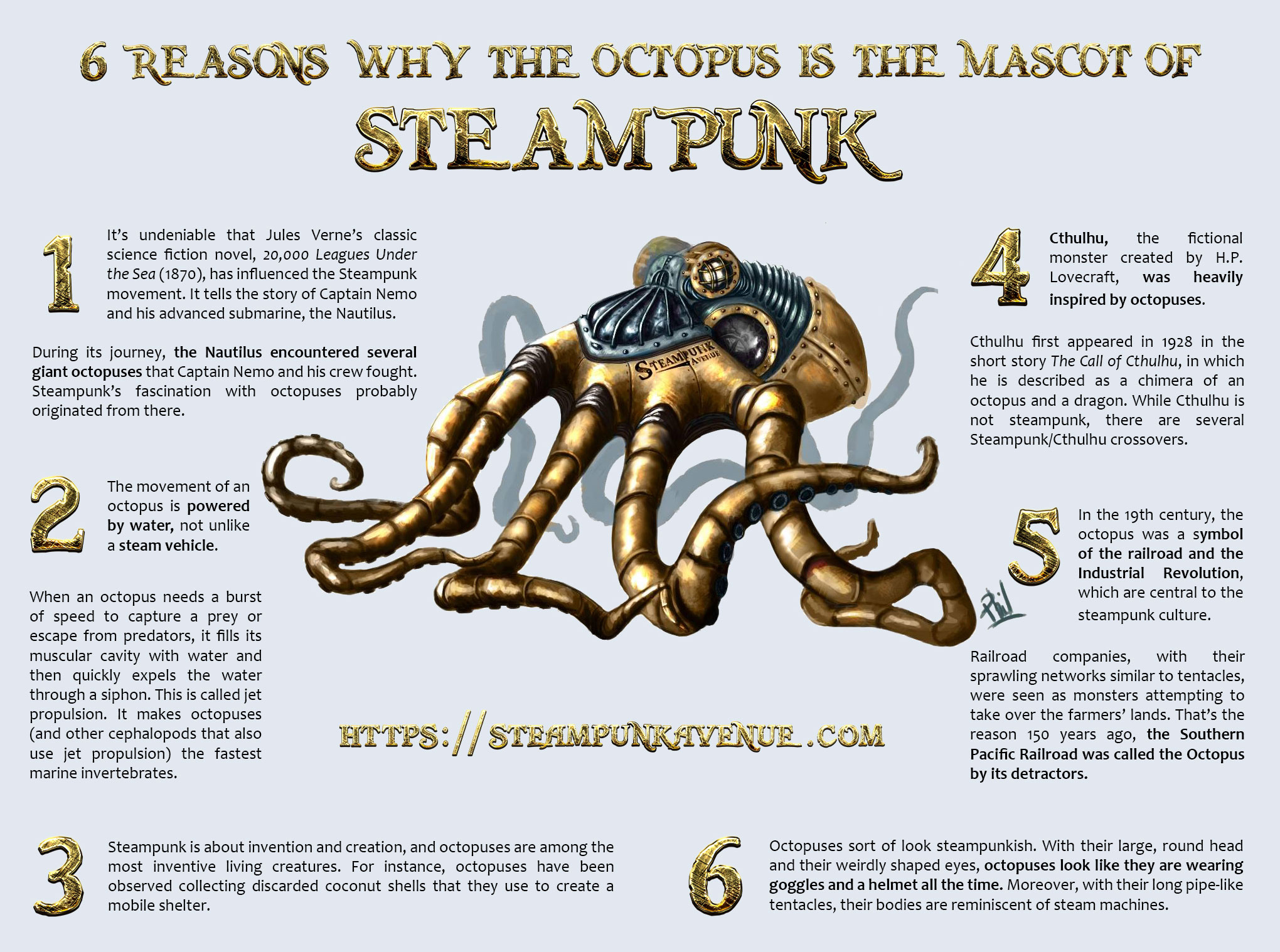
Click or tap the image to view it in full resolution
Neither a passing trend nor a random choice, the octopus earned its place in steampunk through the richness of what it represents. Inherited from Victorian imagery and shaped by literature, science and industrial anxieties, it embodies the movement’s core tensions: fascination with progress, fear of the unknown, and an unapologetic taste for the strange. A creature of the abyss turned retrofuturistic icon, the octopus reminds us that steampunk does not merely romanticise the past—it probes its darker, stranger and unmistakably modern undercurrents.
Sources
1) It’s undeniable that Jules Verne’s classic science fiction novel, 20,000 Leagues Under the Sea (1870), has influenced the Steampunk movement. It tells the story of Captain Nemo and his advanced submarine, the Nautilus. During its journey, the Nautilus encountered several giant octopuses that Captain Nemo and his crew fought. For many, this is where steampunk’s fascination with the octopus truly begins.
2) The movement of an octopus is powered by water, not unlike a steam vehicle. When an octopus needs a burst of speed to capture prey or escape predators, it fills its muscular cavity with water and then quickly expels the water through a siphon. This is called jet propulsion. The mechanism is uncannily mechanical—fluid-driven, pressurised and efficient—and makes cephalopods the fastest marine invertebrates.
3) Steampunk is about invention and creation, and octopuses are among the most inventive living creatures. For instance, octopuses have been observed collecting discarded coconut shells that they use to create a mobile shelter. Biological tinkerers long before the word “maker” existed.
4) Cthulhu, the fictional monster created by H.P. Lovecraft, was heavily inspired by octopuses. Cthulhu first appeared in 1928 in the short story The Call of Cthulhu, in which he is described as a chimera of an octopus and a dragon. While Cthulhu is not steampunk, the visual and thematic overlap has spawned countless steampunk–Cthulhu crossovers.
5) In the 19th century, the octopus was a symbol of the railroad and the Industrial Revolution, which are central to the steampunk culture. Railroad companies, with their sprawling networks similar to tentacles, were seen as monsters attempting to take over the farmers’ lands. That’s the reason, 150 years ago, the Southern Pacific Railroad was called the Octopus by its detractors, accused of strangling local economies in the name of progress.
6) Octopuses sort of look steampunkish. With their large, round head and their weirdly shaped eyes, octopuses look like they are wearing steampunk goggles and a helmet all the time. Moreover, with their long pipe-like tentacles, their bodies are reminiscent of steam machines. Frankly, they look as if they were designed by a Victorian engineer with a flair for the bizarre